In The Culture Code, Daniel Coyle describes culture as the set of living relationships between a group of people working towards a shared goal. Coyle goes on to say that culture is not something “you are”, but something “you do”.
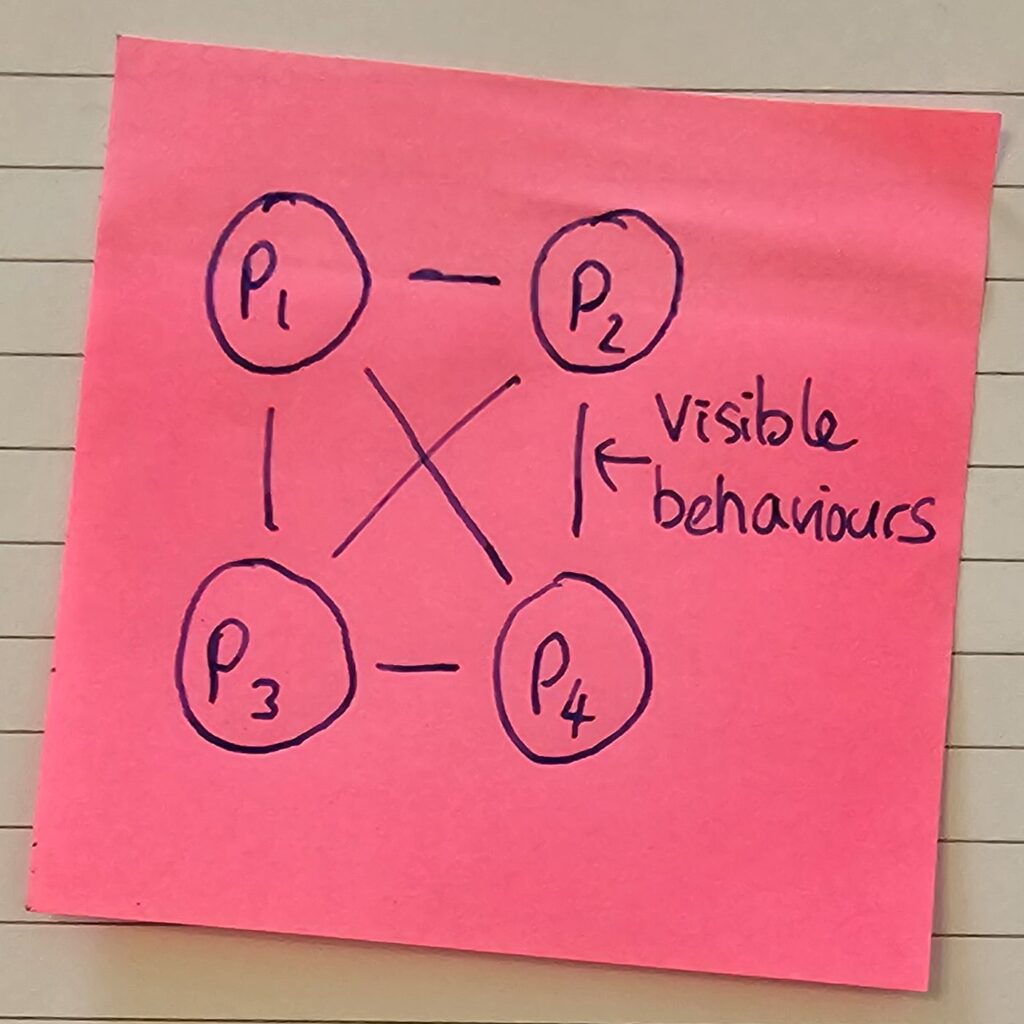
When reading this I imagined a network diagram of an organisation, with the people being represented as nodes in the network and the lines between the nodes represent the relationships between the people. These relationships, I reasoned, will be visible by the behaviours the people exhibit.
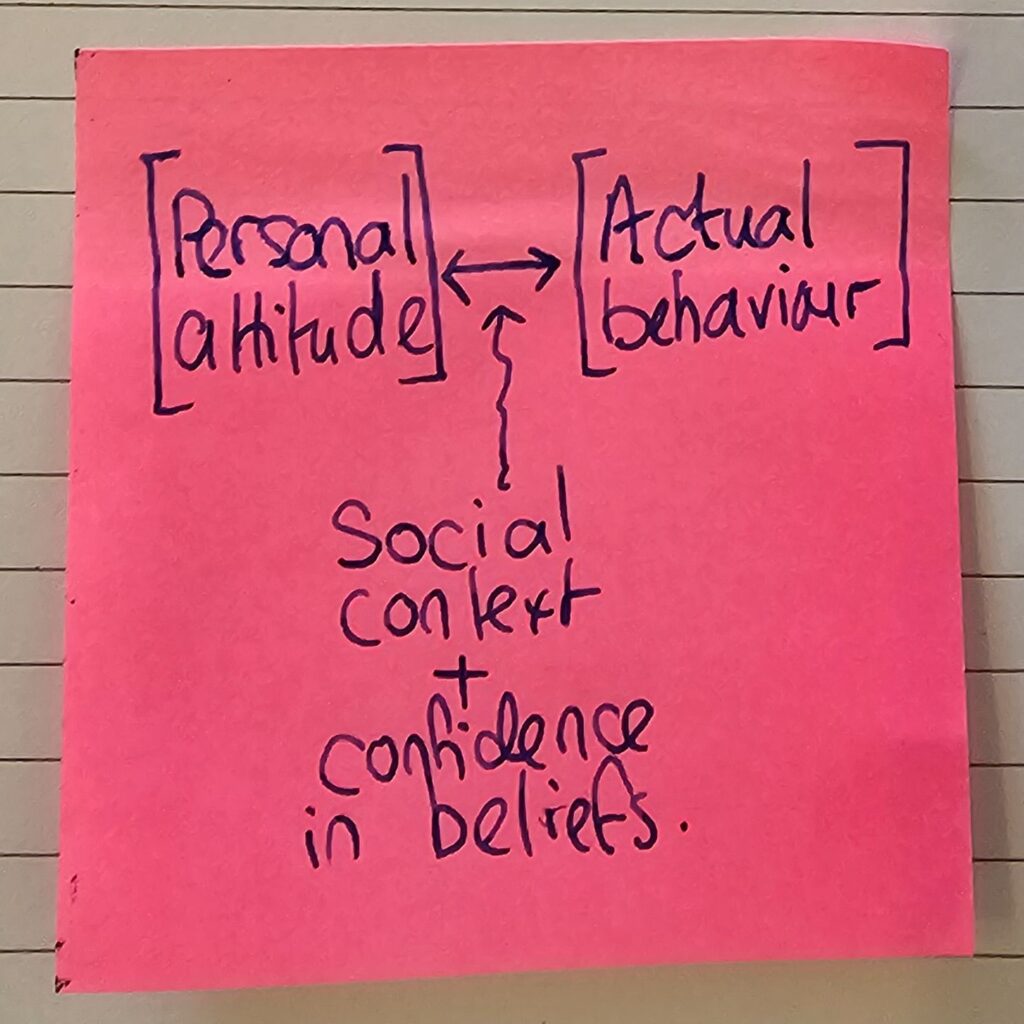
Now, in Psychology of Human Behaviour, Addison Bell describes how the behaviours people exhibit can differ from their actual personal attitudes and beliefs. Bell gives two potential reasons for this. Firstly, the social context / social implications at stake, for example when telling a “white lie” to avoid hurting a friend’s feelings. And secondly the certainty / confidence a person has in their attitudes, based on how consistent these attitudes have remained over time.
When thinking about this type of group behaviour, I was also reminded about the process of Social Contagion. This is something I had started to notice and think about at work a few years back, causing me to look it up and read more about the topic.
In Emotional Agility, Susan David describes Social Contagion as the phenomenon where other people’s behaviours can transmit through a group, similar to a cold or flu, potentially affecting us more than we realise. David cites a study carried out on a quarter of a million airline passengers, which found that passengers were 30% more likely to make an in-flight purchase (such as a movie or snack) if the person sitting in the seat next to them made a purchase first.
Taking this concept further, in Algorithms to Live By, Brian Christian and Tom Griffiths cover the topic of Information Cascade within their chapter on Game Theory. The chapter in general provides evidence for, and examples of, how irrational behaviour can manifest at the group level, even if each individual within the group is acting rationally.
In the example of Information Cascade, Christian and Griffiths describe how our tendency to copy the behaviour of others (Social Contagion), while at the same time exhibiting behaviours that may not align with what we actually think, can result in situations where the whole group is acting on essentially infinite levels of misinformation. Examples given include the 2007-2009 mortgage crisis, where a generation of homebuyers believed that houses were a fail-safe investment that could only go up in value, and bankers believed they were doing the right thing by making available opportunities to buy.
In conclusion to the section on Social Contagion, David describes how having an understanding of our governing values can help prevent the exhaustion related with managing the incongruence between our actual attitudes and exhibited behaviour, and can help prevent us making decisions that (in the best case) do not align with what we actually want to do, or (in the worst case) don’t even serve us. Similarly, being clear on our values also supports the confidence needed to ensure our behaviours are consistent with our attitudes (as called for by Bell).
In conclusion to the section on Information Cascade, Christian and Griffiths advise that doing what we think is right (i.e. acting in alignment with our values), instead of going along with the herd, is likely to mean we are wrong more often than we are right, but over time it will become clear to the group that our beliefs can be reliably inferred from our actions.
I don’t have any firm conclusion to put here right now. It’s been a long time since I wrote anything like this, however I have been reading a lot of material on these and similar subjects and feel the need to start stringing those chains of thoughts together in a way that University assignments used to force me to do.
One idea I was toying with this morning is “potential cultures”. If the relationships / behaviours we see today (the current culture) are not totally representative of the actual attitudes, beliefs and values of the individuals, but are instead more a representation of how the individuals think they must behave to fit in with the group, then what methods could an organisation use to foster one of the multitude of other potential cultures?
DW.
References
The Culture Code, Daniel Coyle
Psychology of Human Behaviour, Addison Bell
Emotional Agility, Susan David
Algorithms to Live By, Brian Christian and Tom Griffiths